LGBT — Let’s Go By Transit: Why Improving Queer Mobility Benefits Everyone
Written by Sarah Lucas
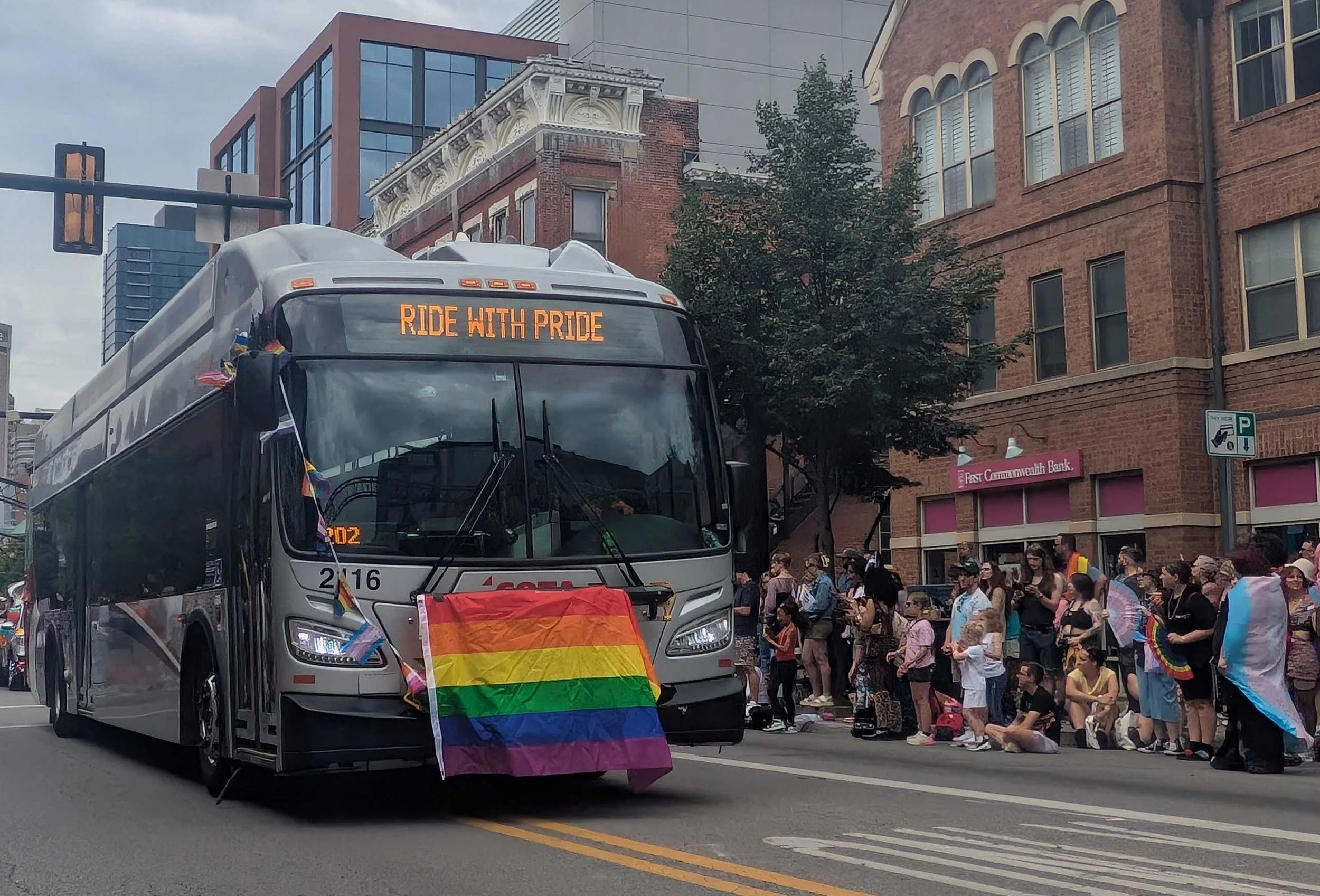
Gay COTA bus at Columbus’ 2026 Pride parade (Photo by author).
As Pride Month ends, I’ve been reflecting on the power of movement via transit and its importance within the queer community. In the last two years, I’ve learned a lot about mobility and transport justice - two concepts that weave together powerfully within the LGTBQIA+ community and the values of Pride Month.
Dr. Amy Lubitow, a professor at Portland State University who researches mobility, states, “Transport justice means not just increasing accessibility for different transport modes across the city but attending to how the characteristics of certain modes of travel exclude marginalized groups of people.” As the queer community is already more likely to live in poverty and rely on public transportation more heavily than other groups, poor public transit and lack of access strongly impacts the health, social and economic opportunities, and quality of life for LGBTQIA+ individuals.
Transportation enables and empowers queer people to access critical healthcare services, such as gender-affirming care, mental healthcare, and HIV treatment and prevention. It connects riders to grocery stores, employment, recreation, and social connections. Public transit may be the only option for a gay teen attending Pride, a transman obtaining hormone therapy, a queer woman visiting a lesbian bar, or a parent and their queer child visiting the library in search of inclusive media. As Bay Area transit advocate Alec Edges affirms, “Public transit…gives you the freedom of access, the freedom to be able to be who you are.”
However, it is not simply access to transportation that matters — the transit quality and supporting infrastructure are also vital. Insufficient infrastructure, like poor lighting and lack of bus shelters, along with long wait times, exposes queer riders (particularly transgender and gender-nonconforming ones) to increased harassment and risk of violence. Bus stops with just a signpost in the ground are unfortunately all too common in Columbus, and represent an increased safety risk and unwelcoming atmosphere particularly to queer riders.
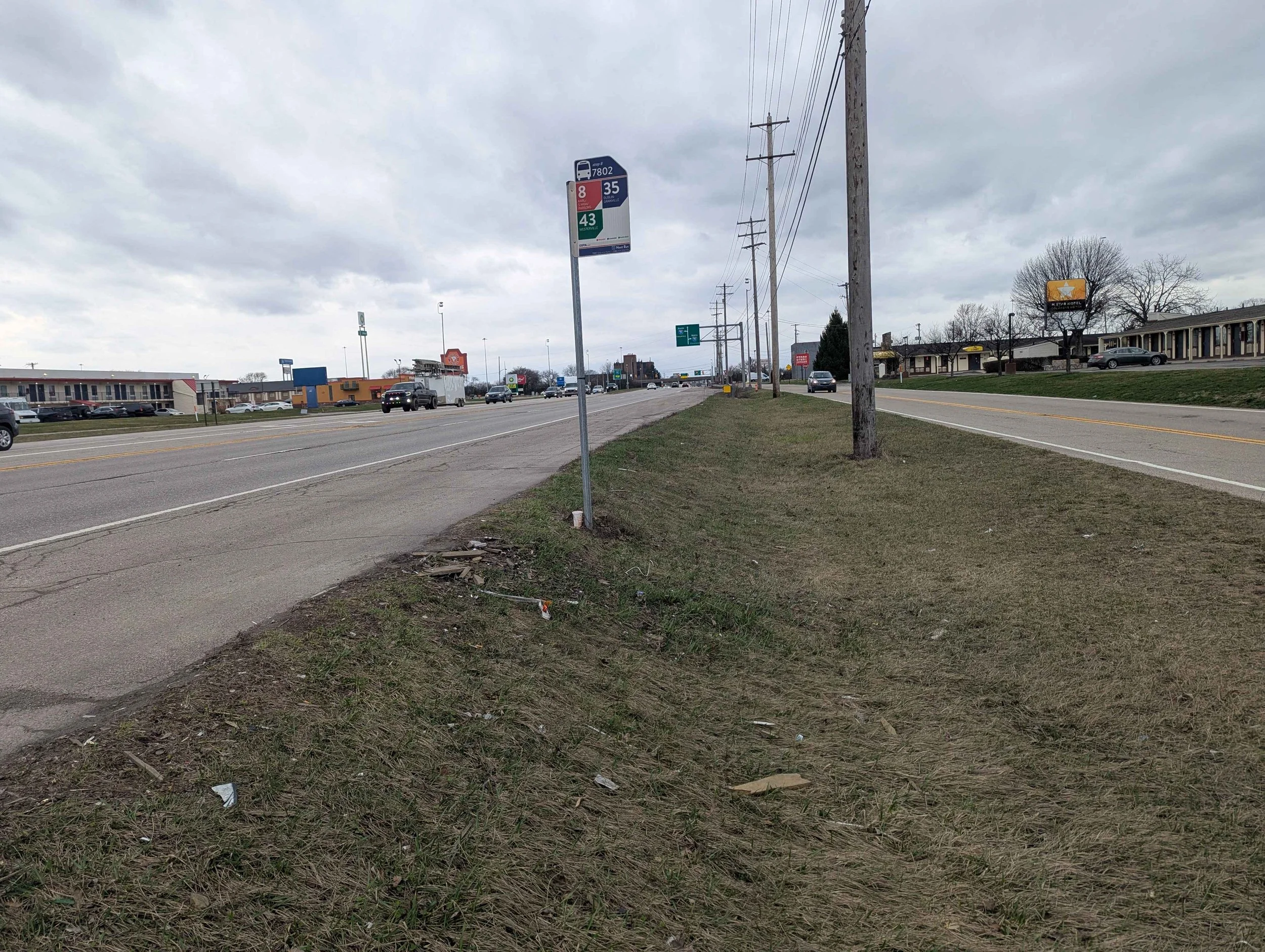
“Ditch of Despair,” Columbus bus stop number 7802 — Champion of the Transit Columbus 2026 “March Madness Bus Stop Bracket,” spotlighting subpar bus stops (Photo by a Transit Columbus member).
As a city with a higher percentage of citizens identifying as queer than cities like NYC, Washington DC, and Chicago, these bus stops are a poor reflection of Columbus, particularly given how our vibrant LGTBQIA+ community is. The Central Ohio region is also on track to reach nearly 3.15 million residents by 2050 and as a result, our queer population will also grow. However, with 34% of trans people reporting discrimination, harassment or assault while using transit in one year, we need our public transit infrastructure to protect our community and eliminate barriers to existing and potential queer riders and residents (That stat is from 2015 and, given the large change in the political climate since, I would not be surprised if that number is even higher today).
Boarding transit doesn’t eliminate problems either, as queer people are still vulnerable while riding. The risk of harassment continues, through potential for discrimination by fellow riders or transit workers. It can be something as seemingly small as being misgendered while boarding or being ogled at by other riders. Similarly, within the enclosed confines of public transit, the feeling of being “trapped” generates additional safety concerns — there is no place to escape between stops if harassment or assault occurs.
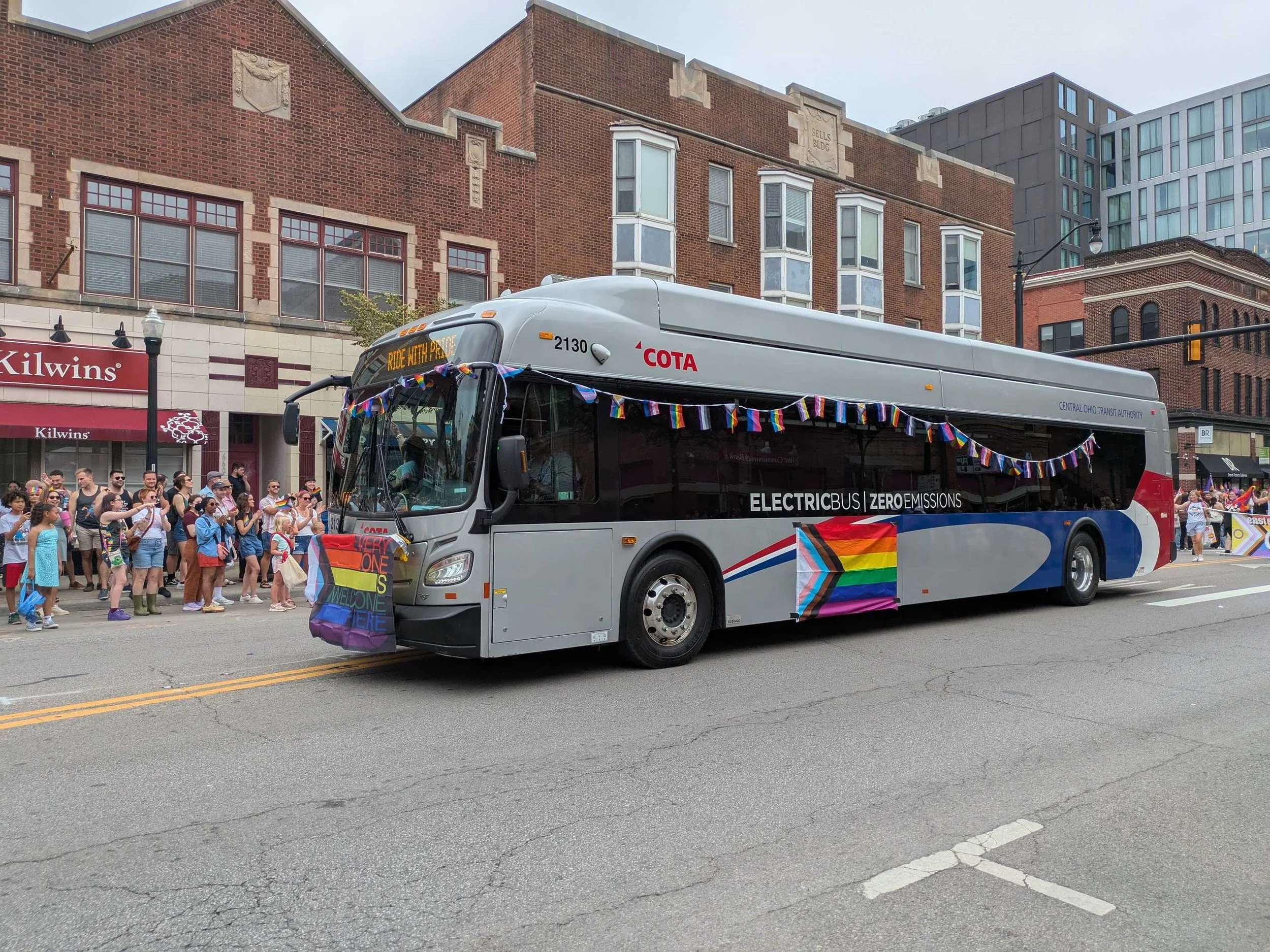
Gay COTA bus from a different angle (Photo by author).
So, how can we make transit more inclusive for queer riders? The improvements could be as big as increasing frequency, bettering schedule reliability, improving stops with lighting, panic buttons, and shelters, or enhancing staff training. Or as small as ensuring Wi-Fi and network connectivity at stops and on board, running awareness campaigns on inappropriate rider behavior and bystander intervention, or annually auditing stops to assess safety.
All of these suggested improvements can have a substantial impact on the safety of LGBTQIA+ riders, but they also benefit everyone else. Jeffrey Tumlin, the first openly gay Director of Transportation of the San Francisco Municipal Transportation Agency said in an 2023 interview that “one of the most crucial indicators for me about whether we’re doing right by transit is how safe trans women feel on transit and how safe children feel...If we can serve these populations, we can serve everyone.”
With the passage of LinkUS, Columbus will see some of these improvements. COTA has already increased bus service by 8.5%, expanded hours, and improved frequency on eight different lines. Additionally, the planned bus rapid transit (BRT) lines will include high frequency buses, sheltered and lighted stops, and other amenities.
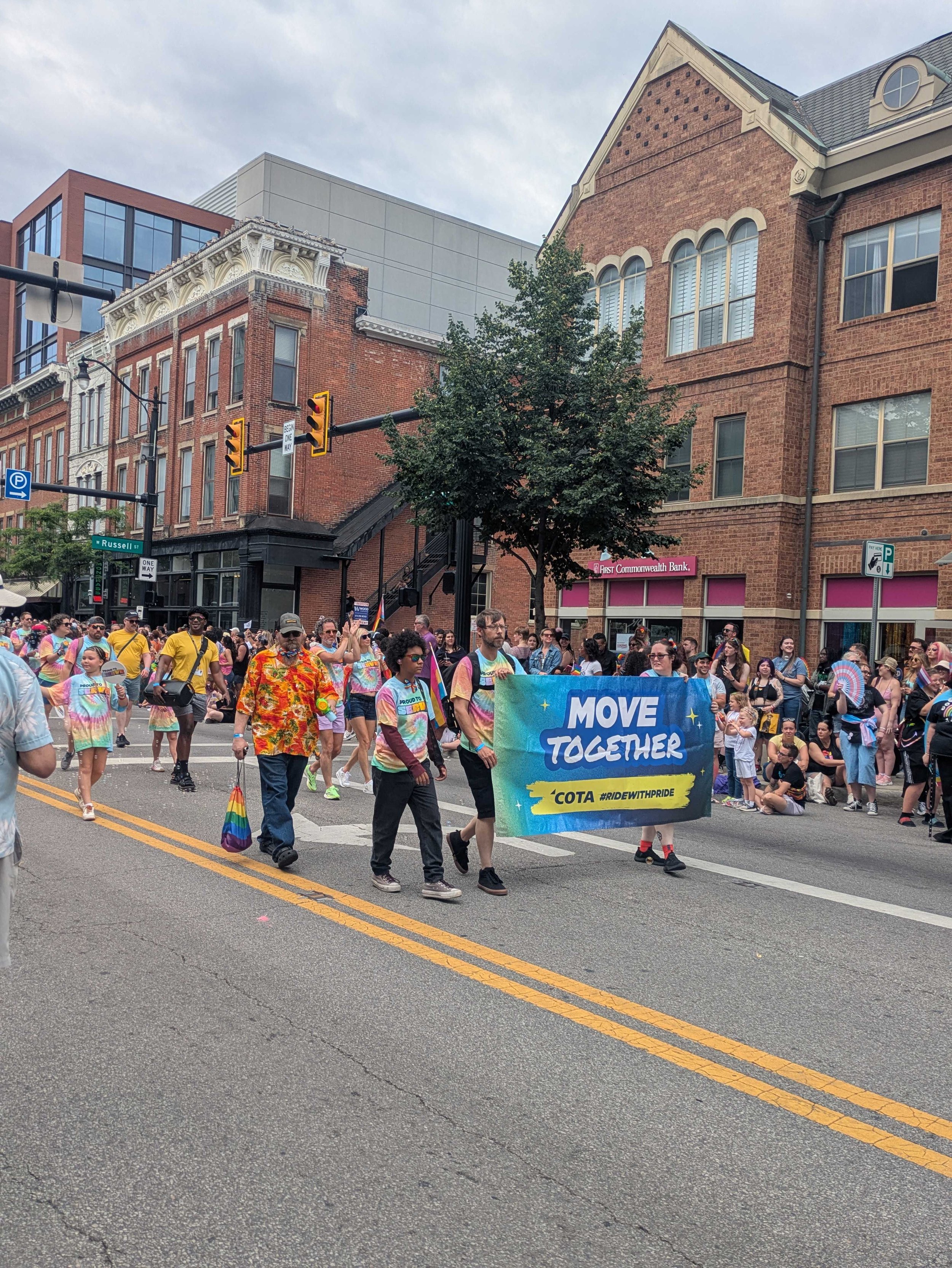
COTA staff marching in the 2026 Columbus Pride parade (Photo by author).
By protecting the most vulnerable riders, public transit agencies can offer dignity, safety, and inclusion to all. A beautiful thing about public transportation is that it is one of the few remaining shared public spaces where people of all background intermingle. It provides individuals an opportunity to experience others and understand their impact on those around them. There’s another wonderful quote from Jeffrey Tumlin: “Transit is a little social island where we’re continually adjusting our behavior and creating new social rules…It’s on transit where we can figure out the intersection of being our true selves and being a person who might be accepted in society…Every single bus ride is a practice run at that.”
Let’s go ride COTA and practice being human together in this messy, beautiful world.
Happy Pride, y’all.
References:
Crawford, R. P., & Schuller, K. (2023). Functional, communicative, and hybrid barriers to accessing mental health care in LGBTQ+ communities. Psychology & Sexuality, 14(3), 513–527.https://doi.org/10.1080/19419899.2023.2181096
He, Q., Rowangould, D., Karner, A., Palm, M., & LaRue, S. (2022). Covid-19 pandemic impacts on essential transit riders: Findings from a U.S. Survey. Transportation Research Part D: Transport and Environment, 105, 103217.https://doi.org/10.1016/j.trd.2022.103217
Hernandez, E., & Kokitkar, T. (2025). Gendered Experiences on Chicago’s Public Transit. University of Illinois Urbana Champaign Department of Urban and Regional Planning. https://prideactiontank.org/wp-content/uploads/2025/07/Gendered-Experience-on-Chicagos-Public-Transit-Report.pdf
Ivanova, O., & O’Hern, S. (2024). Mobility of non-binary and gender nonconforming individuals: A systematic literature review. Journal of Transport Geography, 121, 104008.https://doi.org/10.1016/j.jtrangeo.2024.104008
James, S. E., Herman, J. L., Rankin, S., Keisling, M., Mottet, L., & Anafi, M. (2016). The Report of the 2015 U.S. Transgender Survey. National Center for Transgender Equality. https://transequality.org/sites/default/files/docs/usts/USTS-Full-Report-Dec17.pdf
Lubitow, A., Abelson, M. J., & Carpenter, E. (2020). Transforming mobility justice: Gendered harassment and violence on transit. Journal of Transport Geography, 82, 102601.https://doi.org/10.1016/j.jtrangeo.2019.102601
Lubitow, A., Carathers, J., Kelly, M., & Abelson, M. (2017). Transmobilities: Mobility, harassment, and violence experienced by transgender and gender nonconforming public transit riders in Portland, Oregon. Gender, Place & Culture, 24(10), 1398–1418.https://doi.org/10.1080/0966369X.2017.1382451
Portland State University, Zapata, M., Garcia, I., University of Utah, Lubitow, A., Portland State University, Abelson, M., & Portland State University. (2023). Marginalized Populations’ Access to Transit: Journeys from Home and Work to Transit. Transportation Research and Education Center (TREC).https://doi.org/10.15760/trec.293
Pride Month 2023: On the intersection of LGBTQ+ identity and public transit advocacy | Bay Area Rapid Transit. (n.d.). Www.bart.gov. Retrieved June 15, 2026, from https://www.bart.gov/news/articles/2023/news20230619
Shakibaei, S., & Vorobjovas-Pinta, O. (2024). Access to Urban Leisure: Investigating Mobility Justice for Transgender and Gender Diverse People on Public Transport. Leisure Sciences, 46(5), 639–657.https://doi.org/10.1080/01490400.2021.2023372
Sharpe, J. D., Siegler, A. J., Sanchez, T. H., Guest, J. L., & Sullivan, P. S. (2023). Effects of mode of transportation on PrEP persistence among urban men who have sex with men. AIDS Care, 35(9), 1411–1419.https://doi.org/10.1080/09540121.2023.2217375
Walks, A. (2023, June 15). The Freedom to Move Series - Trans Rights is Mobility Justice. America Walks. https://americawalks.org/freedom-to-move-trans-rights/
Weintrob, A., Hansell, L., Zebracki, M., Barnard, Y., & Lucas, K. (2021). Queer mobilities: Critical LGBTQ perspectives of public transport spaces. Mobilities, 16(5), 775–791.https://doi.org/10.1080/17450101.2021.1958249
Wien, S., Guest, J. L., Luisi, N., Taussig, J., Kramer, M. R., Stephenson, R., Millett, G., Del Rio, C., & Sullivan, P. S. (2023). Racial differences in the association of undetectable HIV viral load and transportation to an HIV provider among men who have sex with men in Atlanta, Georgia: A health equity perspective. AIDS Care, 35(8), 1154–1163.https://doi.org/10.1080/09540121.2023.2182871